FUBiS Term II 2026 (May 30 - July 11)
Departure Day/ Move-Out Day: Saturday, July 11, 2026
You can register until May 2, 2026.
See here for an overview on fees and deadlines.
Interactive course flyer Term II 2026 (pdf)
Program structure:
- An A-Track language course can only be combined with a B-Track subject course.
- An A-Track subject course can only be combined with a B-Track subject course.
- C- and D-Track courses cannot be combined with other courses.
- The number of participants in each course is limited to 18 (15 in language courses). In exceptional cases, more participants per class may be allowed.
Course schedule
A-Track Subject Courses
Language of instruction: English
Course type: Subject course, A-Track
Contact hours: 72 (6 per day)
Course days: Monday & Thursday
ECTS credits: 8
Program fee: € 695
Course fee: € 1,850
Can be combined with all B-Track courses
Course Description
This course is an acting course that introduces the student to the research, writing and performance techniques of cabaret performers.
Kabarett is the German word for "cabaret" but has two different meanings. The first meaning is the same as in English; describing a form of entertainment featuring comedy, song, dance, and theater (often the word "Cabaret" is used in German for this as well to distinguish this form). The latter describes a kind of political satire. Unlike comedians who make fun of all kind of things, Kabarett artists (German: Kabarettisten) pride themselves as dedicated almost completely to political and social topics of more serious nature which they criticize using techniques like cynicism, sarcasm and irony.
As Peter Jelavich stated in his book “Berlin Cabaret (Studies in Cultural History)” that every Metropolis tends to generate an urban mythology and Berlin is no exception. One of the more enduring Fables associated with that city is that it was hotbed for Cabaret.
Students will be seeking to assay that tale by examining Cabaret in Europe and specifically in Berlin from 1901-1944 while creating their own solo performance based on research of sources as such diaries, letters, memoirs, and autobiographies that relate Berlin Kabarett. Subjects can be figures such as Gisela May, Trude Hestberg, Anita Berber, Claire Waldoff, Erwin Piscator, Hugo Ball, Blandine Ebinger, Kurt Weill and are of particular interest to the student.
While studying and analyzing the techniques of a wide variety of cabaret performers through its inception, students will explore aspects of writing monologues and implementing those techniques with the ultimate goal of creating and performing their own material -sense of truth- with the courage necessary to stand-alone on stage.
There will be mandatory field trips to notable Cabaret/Kabarett shows and venues in the city, which will inspire us visually. In addition to history related readings assignments, the course will incorporate Lisa Appignanesi's "The Cabaret" book for an overall understanding of the forms of artistic cabaret which were to emerge as a meeting place for artists where performance or improvisation takes place among peers, and cabaret as an intimate, small-scale, but intellectually ambitious revue.
The class meets twice a week for three 90-minute segments each day.
The two segments of each class typically involve short lectures on historical and theatrical topics as well as seminar-style discussions of the assigned readings. Some class days devote time to in-depth acting exercises, analyzing the solo performance/cabaret vocabulary and technique. Some class days we will use the afternoon segment for film screenings, excursions to sites in the city or working on your final presentation.
Due to the special format of the course and the mandatory field trips, the program fee for “Creating a Solo Performance: Berlin Cabaret/Kabarett” is €695. Please note that additional costs related to the field trips may apply.
Download Syllabus (printable PDF incl. day-to-day schedule)Recommended Course Combinations (Selection)
A-Track Language Courses
Course type: Language course, A-Track
Contact hours: 108 (6 per day)
Course days: Monday, Wednesday & Thursday
ECTS credits: 8
Course fee: € 1,850
Can be combined with all B-Track courses
Student Profile
This course is designed for the beginner student with no previous knowledge of German.
Course Objectives
This course focuses on encounters with various written, spoken and audio-visual texts and exchanges with other course participants. You will develop basic competencies in listening, speaking, reading, and writing, and an understanding of German culture while being enabled to learn reflectively and strategically. The course addresses cultural, political, and historical aspects of the city of Berlin and the German-speaking countries, which you will analyze and compare with your own background and experiences. At the end of the course, you will be able to deal with a range of everyday situations (in a German-speaking environment) and engage in simple conversations.
- use reading strategies to understand the main features of short newspaper articles and literary texts.
- write short texts and revise and correct them independently.
- understand the main features of conversations and lectures dealing with familiar topics.
Recommended Course Combinations (Selection)
Course type: Language course, A-Track
Contact hours: 108 (6 per day)
Course days: Monday, Wednesday & Thursday
ECTS credits: 8
Course fee: € 1,850
Can be combined with all B-Track courses
Student Profile
This course is designed for beginners with basic knowledge of German.
Course Objectives
This course focuses on encounters with various written, spoken and audio-visual texts and exchanges with other course participants. You will continue to develop and expand basic competencies in listening, speaking, reading and writing, and your understanding of German culture while being enabled to learn reflectively and strategically. The course addresses cultural, political, and historical aspects of the city of Berlin and the German-speaking countries, which you will analyze and compare with your own background and experiences. At the end of the course, you will be able to
- deal with various everyday situations (in a German-speaking environment) and engage in simple conversations.
- Successfully use reading strategies to understand short newspaper articles and literary texts.
- write short texts on various topics and revise and correct them independently.
- understand, in some detail, features of conversations and lectures dealing with familiar topics.
Recommended Course Combinations (Selection)
Course type: Language course, A-Track
Contact hours: 108 (6 per day)
Course days: Monday, Wednesday & Thursday
ECTS credits: 8
Course fee: € 1,850
Can be combined with all B-Track courses
Student Profile
This course is designed for students who have successfully completed the basic level of German and who have a sound knowledge of German at the A2 level of the Common European Framework of Reference for Languages.
Course Objectives
This course focuses on encounters with various written, spoken and audio-visual texts and exchanges with other course participants. You will further develop and expand your competencies in listening, speaking, reading and writing, as well as your understanding of German culture while being enabled to learn reflectively and strategically. The course addresses cultural, political, and historical aspects of the city of Berlin and the German-speaking countries, which you will analyze and compare with your own background and experiences. At the end of the course, you will be able to
- use new strategies for learning and using the German language.
- participate in conversations and discussions of various topics in a German-speaking environment.
- successfully use reading strategies to understand texts of various levels of difficulty and from a variety of genres.
- write texts of various length on a range of topics and revise and correct them independently.
Recommended Course Combinations (Selection)
Course type: Language course, A-Track
Contact hours: 108 (6 per day)
Course days: Monday, Wednesday & Thursday
ECTS credits: 8
Course fee: € 1,850
Can be combined with all B-Track courses
Student Profile
This course is designed for students who have successfully completed the basic level and the first part of the intermediate level of German and who have a sound knowledge of German at the B1 level of the Common European Framework of Reference for Languages.
Course Objectives
This course focuses on encounters with various written, spoken and audio-visual texts and exchanges with other course participants. You will further develop and expand your competencies in listening, speaking, reading and writing, as well as your understanding of German culture while being enabled to learn reflectively and strategically. The course addresses cultural, political, and historical aspects of the city of Berlin and the German-speaking countries, which you will analyze and compare with your own background and experiences. At the end of the course, you will be able to
- use new strategies for learning and using the German language.
- participate in conversations and discussions of various topics in a German-speaking environment.
- successfully use reading strategies to understand texts of various levels of difficulty and from a variety of genres.
- write texts of various length on a range of topics and revise and correct them independently.
Recommended Course Combinations (Selection)
Course type: Language course, A-Track
Contact hours: 108 (6 per day)
Course days: Monday, Wednesday & Thursday
ECTS credits: 8
Course fee: € 1,850
Can be combined with all B-Track courses
Student Profile
This course is designed for students who have successfully completed the intermediate level of German and who have a sound knowledge of German at the B2 level of the Common European Framework of Reference for Languages.
Course Objectives
This course focuses on encounters with various written, spoken and audio-visual texts and exchanges with other course participants. You will further develop and expand your competencies in listening, speaking, reading and writing, as well as your understanding of German culture while being enabled to learn reflectively and strategically. The course addresses cultural, political, and historical aspects of the city of Berlin and the German-speaking countries, which you will analyze and compare with your own background and experiences. At the end of the course, you will be able to
- regularly employ new strategies for learning and using the German language.
- participate in conversations and discussions of various topics in a German-speaking environment while being aware of the appropriate linguistic register.
- read and understand texts of various length and from a variety of genres without difficulties
- to write, independently revise, and correct written work that meets the basic requirements for academic writing.
Recommended Course Combinations (Selection)
B-Track Subject Courses
Language of instruction: English
Course type: Subject course, B-Track
Contact hours: 72 (6 per day)
Course days: Tuesday & Friday
ECTS credits: 8
Course fee: € 1,850
Can be combined with all A-Track courses
Course Description
This course explores selected key moments in European art from the 15th to the 20th century, focusing on how artworks were produced, circulated, and interpreted within specific urban, political, and cultural contexts. Rather than offering a linear survey, it investigates pivotal episodes that illuminate broader issues of mobility, identity, and canon formation.
Drawing on case studies from cities such as Florence, Venice, Paris, and Berlin, students will examine how interpretive categories—including national, stylistic, and canonical labels—were historically constructed. From the commissions of Raphael and Michelangelo in 16th-century papal Rome to the emergence of genre painting in the Flemish and Dutch Golden Age, and from the peintres de la vie moderne in 19th-century Paris to the radical experiments of the German avant-garde in the 1920s, the course will investigate artworks in relation to the historical conditions and urban environments in which they were created. It will consider the dynamic interplay between artists and patrons, the tension between local traditions and individual agency, and the broader political, cultural, and social frameworks that shaped the production of images and architecture.
Students will gain understanding of the main art movements and relevant artists from the Renaissance to the postwar period as well as the basic concepts and terminology of art history. Particular attention will be given to the experience of studying artworks in person. Visits to the outstanding collections of Berlin museums and in-class exercises will train students to observe attentively, engaging with the artwork as a complex object of visual, material, and historical meaning. Learning to look closely, as a form of critical attention, is at the core of the course’s methodology.
Download Syllabus (printable PDF incl. day-to-day schedule)Recommended Course Combinations (Selection)
Language of instruction: English
Course type: Subject course, B-Track
Contact hours: 72 (6 per day)
Course days: Tuesday & Friday
ECTS credits: 8
Course fee: € 1,850
Can be combined with all A-Track courses
| 🌍 Critical global issues addressed in this course: Peace, Justice and Strong Institutions (SDG 16) |
Course Description
To successfully overcome the multiple challenges of our time, people must cooperate peacefully with one another. Otherwise, we as humanity will not be able to cope with climate change, ensure equal access to resources and shape a future in which peace, self-determination, freedom, and prosperity are possible.
In this course we discuss what it takes and how it is possible for people to cooperate with each other, solve problems collaboratively and resolve conflicts peacefully. The course examines the different conditions and models for cooperation. To this end, the latest results from cognitive and behavioral research, psychology, sociology, game and systems theory as well as complexity theory are presented and their relevance for creating conditions for cooperation is examined. Building on the scientific foundations, theories and methods for the peaceful resolution of differences and conflicts are then introduced. The focus here is on mediative skills and international peace mediation. However, cooperation and conflict resolution are not just knowledge, but can and must be learned and trained. In the course, students are given the opportunity to transform the knowledge they have learned into concrete skills through role plays and exercises. The experiences gained in the exercises are reflected on together. In this way, knowledge does not remain external, but is linked to concrete experiences. This creates the basis for implementing what has been learned.
The concrete practical relevance is further strengthened by two visits to Berlin NGOs that are active in international peace work. We will also invite guest speakers from the practice of international peace policy and discuss with them. Subject to availability, international guest speakers may also be invited to join the course via video conference.
Berlin has a very special significance for international peace work due to its history. Especially here, students can experience how a society dealt with its own through the Holocaust, war crimes, collapse, liberation, and new beginnings. These experiences will be embedded by visiting memorial sites in Berlin and students will thus be able to use concrete history to shape the future.
Download Syllabus (printable PDF incl. day-to-day schedule)Recommended Course Combinations (Selection)
Language of instruction: English
Course type: Subject course, B-Track
Contact hours: 72 (6 per day)
Course days: Tuesday & Friday
ECTS credits: 8
Course fee: € 1,850
Can be combined with all A-Track courses
Course Description
The ‘Thousand Year Reich’ promised by Hitler when he became Chancellor of Germany in January 1933 lasted but 12 years. During this time, Hitler and his Nazi Party came to dominate the continent, terrorized vast numbers of Germans and Europeans, launched a devastating war, dominated and laid waste to much of Europe, and orchestrated the murder of more than five million Jews. Despite the terror and vast destruction, Hitler and the Nazi Party gained and retained the active support and involvement of most Germans. How was this possible? What roles did seduction and terror, consent and coercion, play?
This class focuses on Hitler’s Germany, and it begins with the 19th century background. Central to this session will be a discussion of the broad political currents, the agitators and petty demagogues who fueled the dissatisfaction and spread it widely. We will also examine the popular literature that Hitler and many of his supporters read and absorbed.
Crucial to understanding the lure of Hitler and the Nazi Party was Germany’s experience in the First World War, a conflict that decimated a generation and destroyed Europe as it was known. In its wake it left a shattered, humiliated, and deeply torn Germany. In this climate of uncertainty and despair, Hitler and the Nazi Party grew from a small group on the fringe of radical politics in Munich into a national force. This development is of central importance to this session. Those traits of Hitler crucial to his success, particularly his charisma, will be defined and analyzed within the broader political context of Weimar political and cultural life.
In late January 1933, Hitler gained the long desired but elusive goal: he became chancellor of Germany, the leader of a coalition government. The political intrigues leading to his appointment will be discussed. Much attention will be paid in this session to how Hitler, his cabinet, and supporters were able to consolidate the control over the state and society within a matter of months. This came at the cost of political liberties, through the growing use of terror, oppression, and intimidation. Yet, Hitler gained supporters as he seemingly offered economic stability and a new unity to the German people. How did the regime solidify its control over society and over political life? Was it seduction or terror, consent or coercion?
A key element of Hitler’s rule was the concentration camp system, what came to be a vast network of prisons, centers of oppression and death. How this developed from the hundreds of small concentration camps set up in Berlin and across Germany shortly after Hitler’s takeover of power in 1933 to the well-organized and highly centralized system by 1939 will be the focus of this session. During the war, the concentration camp system spread across Germany and occupied Europe.
Hitler’s ambitions, the conquest of ‘living space’ in Eastern Europe, the ruthless exploitation of these territories, and the annihilation of the Jews, motivated his foreign ambitions and led directly to World War II, the most destructive conflict in human history. We will also discuss the measures taken against the handicapped, homosexuals, Sinti and Roma within Germany and in the occupied territories.
In Germany and in occupied Europe opposition and resistance emerged and challenged Nazi rule. Opponents were motivated by a variety of reasons, some personal, some political. These too will be discussed as well as the regime’s ruthless efforts to eradicate all opposition.
Lastly, the class will examine the end of the war, the so-called ‘zero hour’, the destruction and collapse of Nazi Germany. Soon, the reckoning with the Nazi past through investigations and criminal prosecutions, and the widespread non-reckoning among the German public, began. Only since the late 1960s has Germany looked openly and critically at its Nazi past and only then began establishing a series of memorials and monuments, a number of which we will be visiting.
We will be visiting local museums, historical sites and locations that reveal the operations and nature of Nazi rule. These visits to sites in and near Berlin are a key element of the class and the experience of studying here. Please note that field trips are subject to change depending on the availability of appointments and speakers; on field trip days, class hours may be adjusted.
Download Syllabus (printable PDF incl. day-to-day schedule)Recommended Course Combinations (Selection)
Language of instruction: English
Course type: Subject course, B-Track
Contact hours: 72 (6 per day)
Course days: Tuesday & Friday
ECTS credits: 8
Course fee: € 1,850
Can be combined with all A-Track courses
|
🌍 Critical global issues addressed in this course: Responsible Consumption and Production (SDG 12); Climate Action (SDG 13) |
Course Description
Climate change, environmental pollution, waste of resources and the decline of biodiversity clearly show mankind that processes of change are necessary. On a policy level, the United Nations Sustainable Development Goals, the Paris climate agreement and the Green New Deal are setting the stage, at the corporate level, standards such as environmental social and governance (ESG) reporting, supply chain integrity and voluntary certification, and diversity are critical to long-term business success.
How are companies innovating towards more sustainability today? What are the criteria, the success factors and the strategic approaches to tackle consumer, policy, employee and societal demand for more sustainability?
This course will look at current sustainability frameworks, sustainable companies and sustainable innovation. The participants will get to know and to apply collaborative tools to be better prepared for a business environment. One focus will be on the development of a sustainable business model or project, based on which we will learn and try out modern methods such as the Sustainable Business Canvas, Design Thinking, Effectuation and the Blue Ocean Strategy.
Download Syllabus (printable PDF incl. day-to-day schedule)Recommended Course Combinations (Selection)
C-Track Language Courses
Course type: Language course, C-Track
Contact hours: 180 (6 per day)
Course days: Monday, Tuesday, Wednesday, Thursday & Friday
ECTS credits: 12
Course fee: € 2,675
Student Profile
This course is designed for the beginner student with no previous knowledge of German. This course is intensive and is intended for dedicated, highly self-motivated students who will take responsibility for their learning.
Course Objectives
This course focuses on encounters with various written, spoken and audio-visual texts and exchanges with other course participants. You will develop basic competencies in listening, speaking, reading, and writing, and an understanding of German culture while being enabled to learn reflectively and strategically. The course addresses cultural, political, and historical aspects of the city of Berlin and the German-speaking countries, which you will analyze and compare with your own background and experiences. At the end of the course, you will be able to
- deal with a range of everyday situations (in a German-speaking environment) and engage in simple conversations.
- use reading strategies to understand the main features of short newspaper articles and literary texts.
- write short texts and revise and correct them independently.
- understand the main features of conversations and lectures dealing with familiar topics.
Course type: Language course, C-Track
Contact hours: 180 (6 per day)
Course days: Monday, Tuesday, Wednesday, Thursday & Friday
ECTS credits: 12
Course fee: € 2,675
Student Profile
This course is designed for beginners with basic knowledge of German. This course is intensive and is intended for dedicated, highly self-motivated students who will take responsibility for their learning.
Course Objectives
This course focuses on encounters with various written, spoken and audio-visual texts and exchanges with other course participants. You will continue to develop and expand basic competencies in listening, speaking, reading and writing, and your understanding of German culture while being enabled to learn reflectively and strategically. The course addresses cultural, political, and historical aspects of the city of Berlin and the German-speaking countries, which you will analyze and compare with your own background and experiences. At the end of the course, you will be able to
- deal with various everyday situations (in a German-speaking environment) and engage in simple conversations.
- Successfully use reading strategies to understand short newspaper articles and literary texts.
- write short texts on various topics and revise and correct them independently.
- understand, in some detail, features of conversations and lectures dealing with familiar topics.
Course type: Language course, C-Track
Contact hours: 180 (6 per day)
Course days: Monday, Tuesday, Wednesday, Thursday & Friday
ECTS credits: 12
Course fee: € 2,675
Student Profile
This course is designed for students who have successfully completed the basic level of German and who have a sound knowledge of German at the A2 level of the Common European Framework of Reference for Languages. This course is intensive and is intended for dedicated, highly self-motivated students who will take responsibility for their learning.
Course Objectives
This course focuses on encounters with various written, spoken and audio-visual texts and exchanges with other course participants. You will further develop and expand your competencies in listening, speaking, reading and writing, as well as your understanding of German culture while being enabled to learn reflectively and strategically. The course addresses cultural, political, and historical aspects of the city of Berlin and the German-speaking countries, which you will analyze and compare with your own background and experiences. At the end of the course, you will be able to
- use new strategies for learning and using the German language.
- participate in conversations and discussions of various topics in a German-speaking environment.
- successfully use reading strategies to understand texts of various levels of difficulty and from a variety of genres.
- write texts of various length on a range of topics and revise and correct them independently.
Course type: Language course, C-Track
Contact hours: 180 (6 per day)
Course days: Monday, Tuesday, Wednesday, Thursday & Friday
ECTS credits: 12
Course fee: € 2,675
Student Profile
This course is designed for students who have successfully completed the basic level and the first part of the intermediate level of German and who have a sound knowledge of German at the B1 level of the Common European Framework of Reference for Languages. This course is intensive and is intended for dedicated, highly self-motivated students who will take responsibility for their learning.
Course Objectives
This course focuses on encounters with various written, spoken and audio-visual texts and exchanges with other course participants. You will further develop and expand your competencies in listening, speaking, reading and writing, as well as your understanding of German culture while being enabled to learn reflectively and strategically. The course addresses cultural, political, and historical aspects of the city of Berlin and the German-speaking countries, which you will analyze and compare with your own background and experiences. At the end of the course, you will be able to
- use new strategies for learning and using the German language.
- participate in conversations and discussions of various topics in a German-speaking environment.
- successfully use reading strategies to understand texts of various levels of difficulty and from a variety of genres.
- write texts of various length on a range of topics and revise and correct them independently.
Course type: Language course, C-Track
Contact hours: 180 (6 per day)
Course days: Monday, Tuesday, Wednesday, Thursday & Friday
ECTS credits: 12
Course fee: € 2,675
Student Profile
This course is designed for students who have successfully completed the intermediate level of German and who have a sound knowledge of German at the B2 level of the Common European Framework of Reference for Languages. This course is intensive and is intended for dedicated, highly self-motivated students who will take responsibility for their learning.
Course Objectives
This course focuses on encounters with various written, spoken and audio-visual texts and exchanges with other course participants. You will further develop and expand your competencies in listening, speaking, reading and writing, as well as your understanding of German culture while being enabled to learn reflectively and strategically. The course addresses cultural, political, and historical aspects of the city of Berlin and the German-speaking countries, which you will analyze and compare with your own background and experiences. At the end of the course, you will be able to
- regularly employ new strategies for learning and using the German language.
- participate in conversations and discussions of various topics in a German-speaking environment while being aware of the appropriate linguistic register.
- read and understand texts of various length and from a variety of genres without difficulties
- to write, independently revise, and correct written work that meets the basic requirements for academic writing.
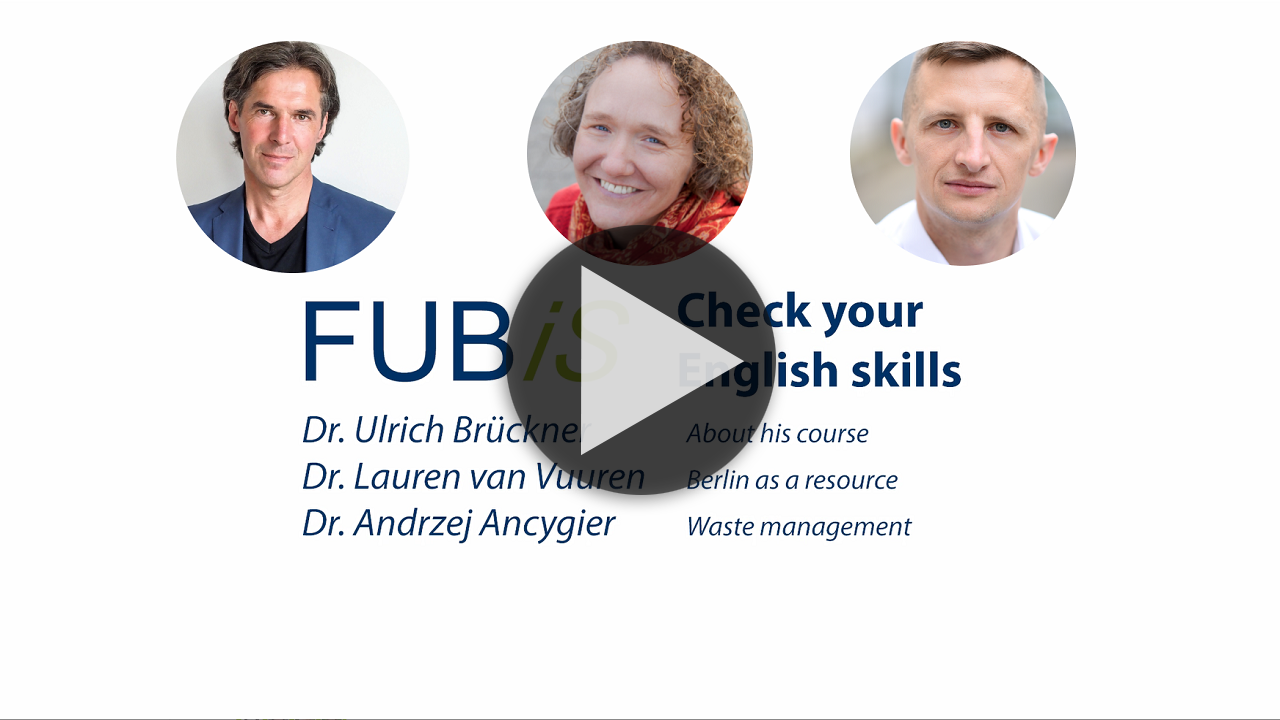
Check your English language skills
To find out if your English skills are sufficient to follow our subject courses, feel free to watch the following video. The language level of the video represents the level used in our courses. If you are not able to understand the video to a large extent, we don’t recommend a participation in an English-speaking subject course. In that case, how about a German Language course?